
The rest of the week.
In the same window.
Contacts, invoices, quotes, hours and sponsorship deals, each one a file. You can do everything here with buttons, and the agent beside you can do all of it from a sentence.
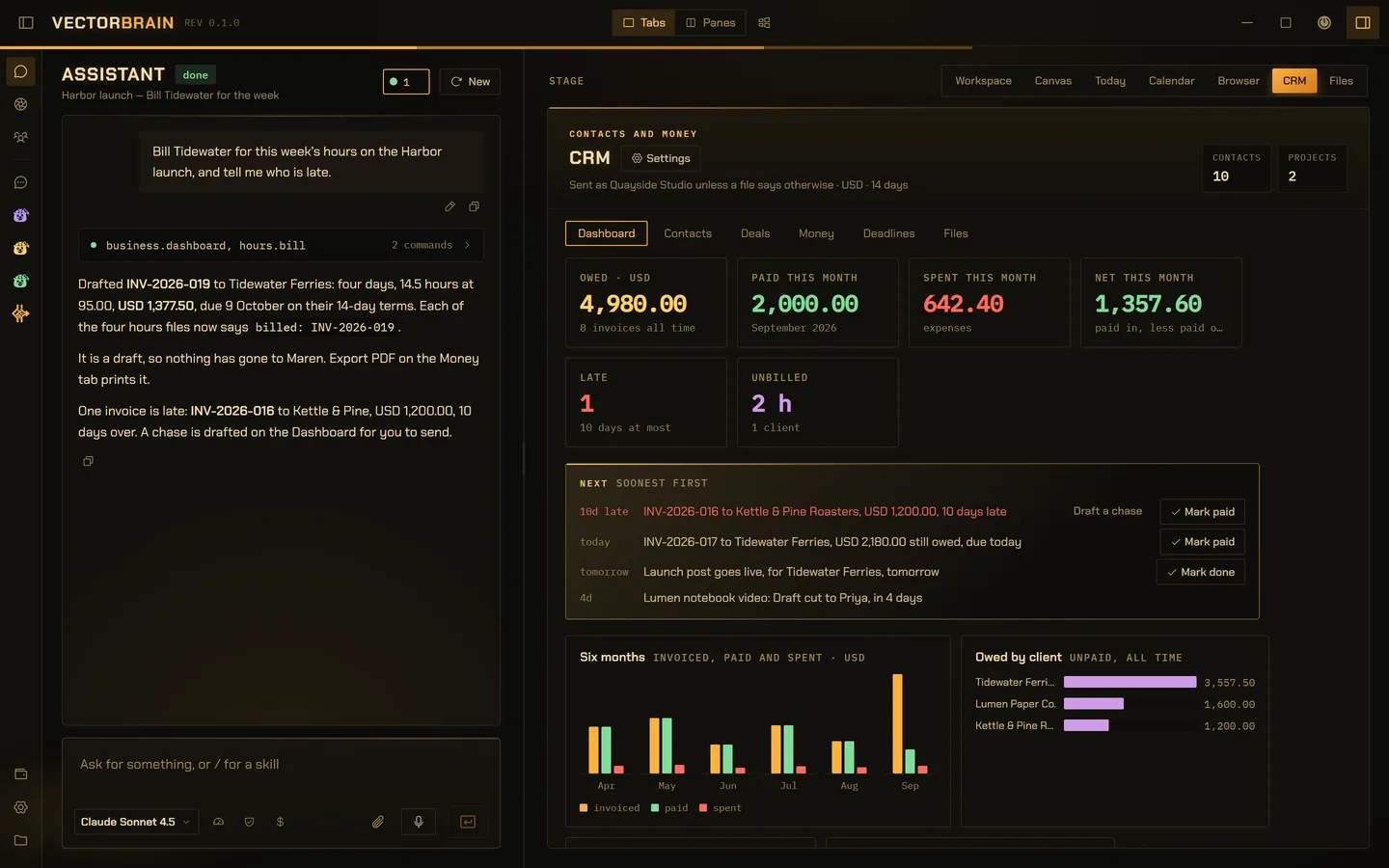
VectorBrain’s real interface, running on an invented business: the people, companies and amounts are made up.
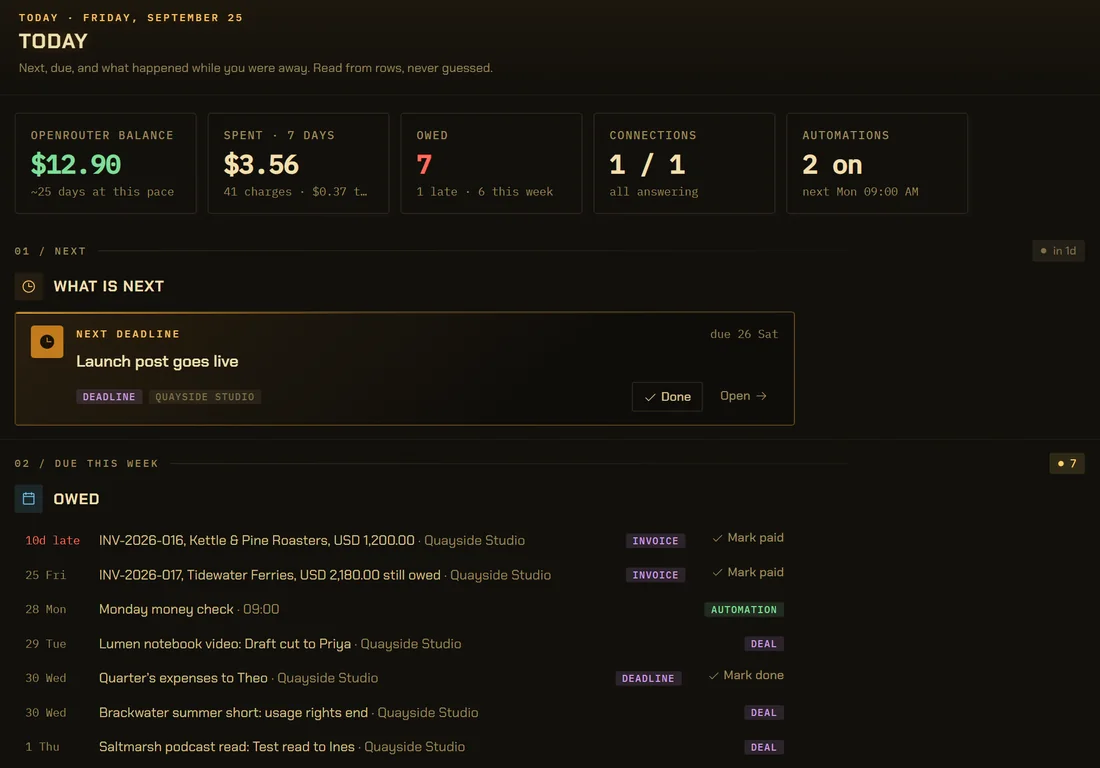
Today is one read, and no model call.
The next deadline, what is owed this week, and what ran while you were away. It is read off your files and the local database, so it costs nothing to keep open beside a conversation.
Done on a deadline and Mark paid on an invoice are the same commands the CRM runs. Nothing here has a second copy of anything.
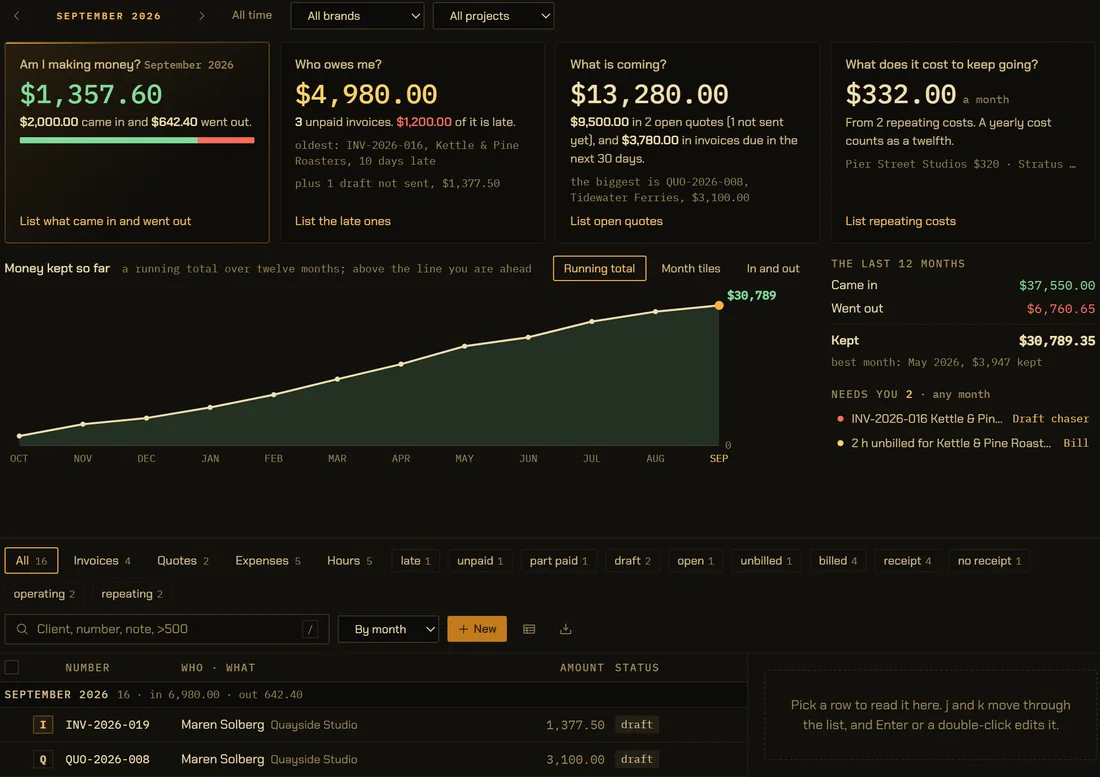
Hours become an invoice. The app does the sums.
hours.bill gathers a client’s unbilled days into one draft invoice and marks each day billed. The rate comes off the file, then the contact, never from the model, and a day with no rate is refused by name.
Every total is added in hundredths by the app. A model is never asked what you earned, because a number recalled rather than worked out is wrong quietly.
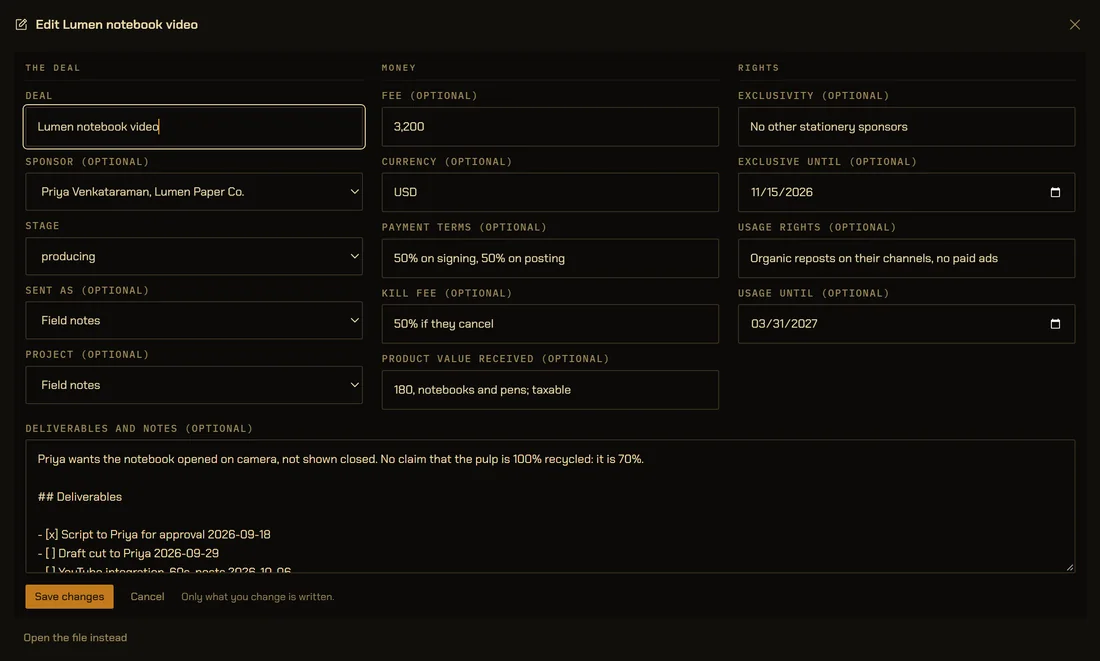
A sponsorship deal is one file you can read.
The sponsor, the fee, the kill fee, the exclusivity, the usage rights and when each one ends. The deliverables are a checklist in the file, so ticking one marks it delivered.
Seven stages, from pitched to paid or lost. Invoice 50% drafts an ordinary invoice to the sponsor, so the money needs nothing new to count it.
Every date lands on one month.
Each dated deliverable, and the day exclusivity and usage rights end, sits beside invoices due, deadlines, retainers and the jobs the app promised to run.
It is one read with no model call, so it cannot invent a meeting. An end date is never shown as late: once it passes, it is done.

Bring the list you already have.
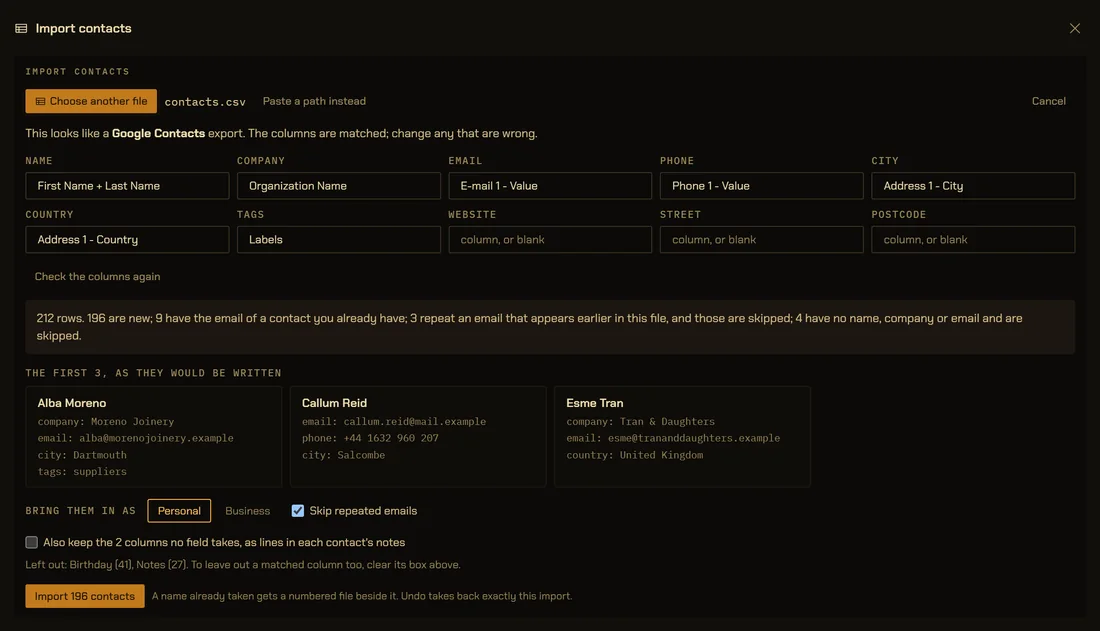
A Google or Outlook contacts export, or a card statement as expenses. You see the matched columns, the duplicates and the first three files before a byte is written.
Every row becomes its own file, and Undo takes back exactly that import. Import reads a file from anywhere on your disk, so only you can run it, never the agent.
- send an invoice
- convert a currency
- print an account number
- file your VAT
- guess a total
It keeps the records and drafts the documents. A chase is a draft for you to send, a retainer is a nudge on the 1st and never an invoice by itself, and totals in two currencies stay two lines. It is a record, not accounts: no VAT, no tax categories, no double entry. The agent cannot create or delete the books, or import from outside them.
The business half in numbers.
- Where it lives
- One folder under your VectorBrain home: business.md plus contacts/, deals/, invoices/, quotes/, expenses/, receipts/, hours/ and deadlines/
vb-cmd-fs/src/walk.rs - Contact fields
- 19 header keys, from name and email to rate, terms, status and a monthly retainer
vb-cmd-core/src/businesses.rs - Deal stages
- 7: pitched, negotiating, signed, producing, posted, paid, lost
vb-cmd-memory/src/ladder.rs - Invoice numbers
- INV-2026-019, one over the highest, claimed so two drafts can never share one; quotes are QUO-, credit notes CN-
vb-cmd-core/src/business_invoice.rs - Lines per invoice or quote
- Up to 60; the app multiplies qty by unit
vb-cmd-core/src/business_invoice.rs - A quote stands
- 30 days from issue unless it says otherwise; accepting it drafts the invoice
vb-cmd-core/src/business_quote.rs - Money arithmetic
- Exact hundredths, per currency, never converted, never a model
vb-cmd-core/src/business_money.rs - Looks ahead
- 7 days for the dashboard’s week, 90 days for what is coming
vb-cmd-core/src/business_dashboard.rs, business_overview.rs - Branded invoices
- A brand’s PNG or JPEG logo up to 2 MB, and three colours: ink, accent, paper
vb-cmd-core/src/brand_look.rs - For the accountant
- Five CSV sheets: contacts, deadlines, deals, invoices, expenses
vb-cmd-core/src/business_csv.rs
The details,
for the careful.
Where does VectorBrain keep contacts and invoices?
In Markdown files, one per contact, deal, invoice, quote, expense, day of hours and deadline, in one folder under your VectorBrain home. A contact is a header of known keys with notes and a dated log under it. You can read them without the app, keep them in version control, and leave with them.
Can the AI agent use the CRM, or only me?
Both. Every button runs a command the agent can also call, so “bill Tidewater for this week” in a conversation does what Bill these does on the dashboard. A new contact is one file write with the known header keys. Four things are yours alone: creating the books, deleting them, tying a project to a client, and importing a CSV. One set of commands
How does an invoice get made?
invoice.draft claims the next number, INV-2026-019, and writes the file with the lines and totals worked out by the app. hours.bill does the same from a client’s unbilled days, and quote.accept does it from a quote’s lines and links the two. Export PDF prints it beside the file, wearing the brand it is sent as. Marking it paid, or part paid by an amount, is one command.
What happens when a client was overcharged?
A sent invoice is never edited, because the client has a copy of what it said. A credit note, CN-2026-001, is a second file with a negative amount that names the invoice it reduces. It cannot be larger than that invoice, and a draft is edited rather than credited.
What does an invoice look like?
An invoice sent as a brand carries that brand’s logo, a PNG or JPEG up to 2 MB, and its three colours: ink for the words, accent for rules and the total, and paper for the page. The sender block comes from the brand’s own brief. With no brand it is a plain invoice with the business’s name. Each business can override the template with one HTML file.
Can it take payments or send invoices?
No. It keeps the record and drafts the documents; you send them. A chase for a late invoice is drafted from the facts for you to copy. The payment line refuses anything shaped like an account number, and the PDF export refuses it again, so bank details never end up in a file an agent reads.
Is it accounting software?
No. It is a record, not accounts: no VAT, no tax categories, no reconciliation and no double entry. Totals are per currency and never converted. For the year end it writes five CSV sheets an accountant can open, with any file it could not count listed with the reason.
What is a sponsorship deal in VectorBrain?
One file per deal in deals/, for people who make things in public: the sponsor, fee, payment terms, kill fee, product received, exclusivity, usage rights and their end dates in the header, and the deliverables as a checklist in the body. Each dated deliverable and both end dates appear on the Calendar and on Today.
What does Today cost to keep open?
Nothing. Today is one idea.today read: headers off your pages and rows out of the local database, with no model call. The Calendar is the same, one idea.month read, and your own calendar, when connected through an MCP server, is read and never written back.
Keep your books
where your work is.
Files you own, sums the app works out, and an agent that can do the paperwork while you do the work.